




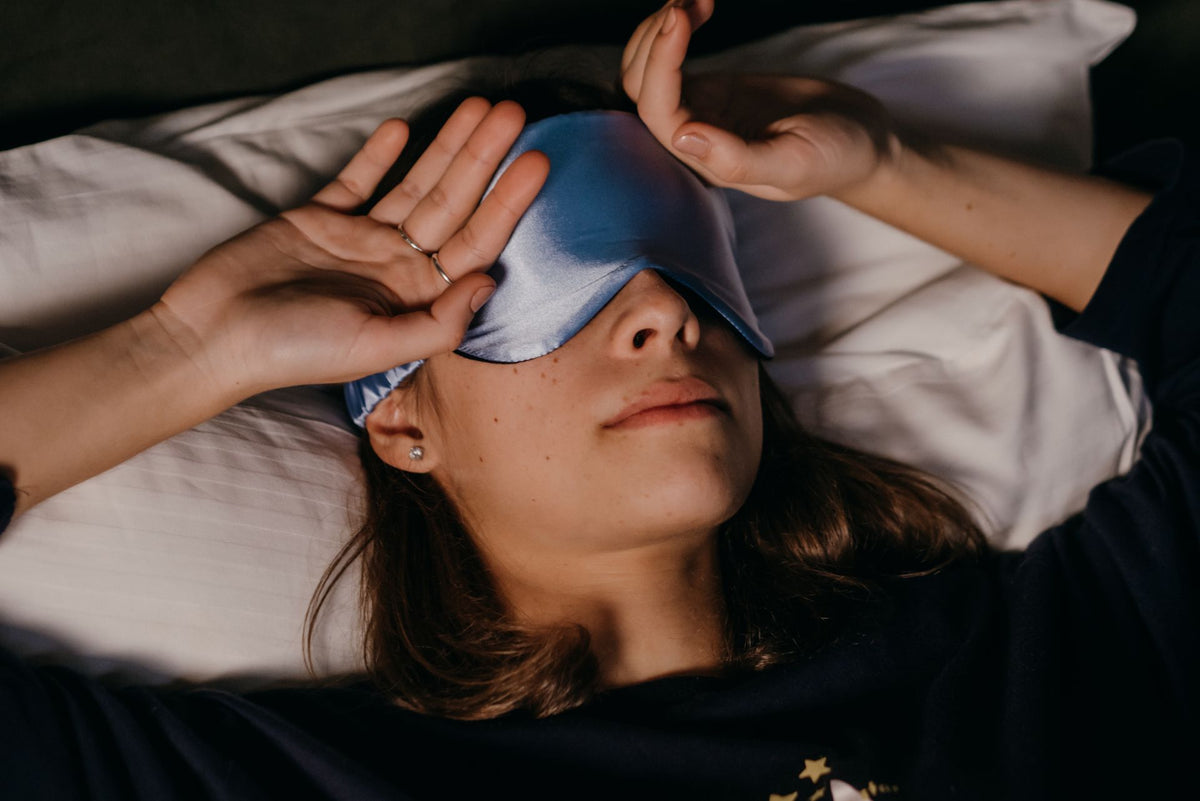
Lying awake while the clock ticks on is exhausting, and the harder you try, the further away sleep can feel. If you want to know how to fall asleep fast, the most reliable route is to calm your body first so your mind can follow. This guide collects 15 techniques, from breathing and muscle relaxation to bedroom tweaks and the steady pressure of something heavy to hold. Each one comes with a short step you can try tonight.
The short answer: to fall asleep faster, slow your breathing, release tension in your muscles, keep your bedroom cool and dark, and go to bed at the same time each night. Start with one or two techniques and give them a few nights to work.
How long should it take to fall asleep?
Before you start timing yourself, it helps to know what normal looks like. A healthy sleep latency, the time between lights out and falling asleep, typically ranges from 15 to 20 minutes. Taking less than 10 minutes may be a sign that you are short on sleep, so a few minutes of drifting is nothing to worry about.
When people want to fall asleep fast, what they usually mean is skipping the long stretch of tossing and turning. That stretch usually comes from a body that is still on alert: tense shoulders, a quick heartbeat and thoughts that keep looping. The techniques below work on exactly that.
Breathing and relaxation techniques to fall asleep fast in bed
These seven methods need nothing but you and a few quiet minutes. Pick one or two and practice them regularly before you judge them, because most relaxation skills get quicker with repetition.
1. The military method
Often called the army sleep trick, the military method was developed to help soldiers fall asleep in two minutes, though little scientific research backs up that promise. It works as a slow, top-to-bottom release of tension.
- Relax every part of your face, including your jaw and the muscles around your eyes.
- Let your shoulders drop and your arms rest at your sides.
- Breathe deeply and let your chest loosen with each exhale.
- Relax your hips, then your legs, all the way down to your feet.
- Picture a peaceful place, such as a quiet countryside, and let passing thoughts drift by.
Try tonight: run through the sequence once with your eyes closed, then simply start again from your face if you are still awake.
2. 4-7-8 breathing
This breathing pattern slows your breath and gives your mind a simple count to hold on to. Breathe out fully through your mouth. Then inhale quietly through your nose for four seconds, hold your breath for seven seconds and exhale slowly through your mouth for eight seconds.
Try tonight: repeat the cycle three to four times, then let your breathing return to its own pace.
3. A longer exhale
If holding your breath feels uncomfortable, focus on the out-breath instead. A longer exhale supports the parasympathetic "rest and digest" response, the part of your nervous system that tells your body it is safe to switch off.
Try tonight: try a 4-second inhale and a 6–8-second exhale, and keep going for a few minutes.
4. Progressive muscle relaxation
Progressive muscle relaxation teaches your body the difference between tension and release. Tense your face muscles for 10 seconds, let go and take a few deep breaths. Move on to your shoulders, then work your way down through each muscle group to your feet, skipping any area that hurts.
Try tonight: start with your shoulders and hands if a full round feels like too much.
5. A body scan
A body scan is the gentle cousin of muscle relaxation. Instead of tensing, you move your attention slowly from your toes to the top of your head and simply notice each area: warmth, weight, tightness or ease. Noticing is enough, and many people find the body softens on its own along the way.
Try tonight: pay special attention to where your body touches the mattress and let each of those spots feel heavier.
6. Guided imagery
Recalling a calm memory or imagining a peaceful scene gives racing thoughts somewhere else to go. Fill in the sensory details, such as the sound of waves, the smell of pine or the feeling of sun on your skin. Breathe slowly as you explore it. Guided imagery recordings can help if you find it hard to steer your thoughts on your own.
Try tonight: choose one place and return to it every night, so it becomes a familiar calm cue.
7. Paradoxical intention
It sounds backwards, but telling yourself to stay awake can help you drift off. Lie in bed with your eyes open and calmly think, "I'm not going to fall asleep." This takes away the pressure of trying, which is often what keeps your mind busy in the first place.
Try tonight: use it when you notice yourself checking the time or counting how many hours of sleep you have left.
How pressure and weight help your body settle
All of the techniques above try to shift your nervous system from alert to calm. Steady, even pressure on the body aims for the same thing through touch. Occupational therapists call it deep pressure stimulation, and people often describe it as feeling securely held. The pressure stimulates the sense of touch and the sense of your muscles and joints, which makes you more aware of your body and its limits.
Researchers from Karolinska Institutet and Karolinska University Hospital in Stockholm describe evidence suggesting that deep pressure increases parasympathetic activity while reducing the "fight or flight" side of the nervous system. They consider this the cause of the calming effect.
8. Hold something heavy and soft
You do not need a full-body blanket to feel this. Holding a weighted plush against your chest or resting it across your lap gives a smaller, more personal kind of deep pressure, much like a steady, reassuring hug. This is the idea Brease is built around: our weighted stuffed animals are filled with glass beads spread across six compartments, so the weight stays even while you hold them.
Try tonight: hold your weighted companion against your chest while you do the longer-exhale breathing from technique 3, and let your arms grow heavy around it.
9. Sleep under a weighted blanket
A weighted blanket spreads deep pressure across your whole body. In a 2020 randomized study from Sweden, 120 patients with insomnia and a psychiatric diagnosis such as depression, bipolar disorder, generalized anxiety or ADHD slept with either a weighted chain blanket or a light plastic chain blanket for 4 weeks. Nearly 60% of the weighted blanket users had a decrease of 50% or more in their insomnia severity score, compared with 5.4% of the control group (Ekholm et al., 2020).
The study looked at people with both insomnia and a psychiatric diagnosis, so results may differ for others, and research in this area is still young. Weighted products are not for infants, and anyone using one should be able to remove it on their own.
Try tonight: start your wind-down with the weight on you while you read, so your body links the feeling with rest.
Set up your bedroom to fall asleep faster
Your surroundings send signals to your body long before you close your eyes. A room that is quiet, dark and cool makes every other technique on this list easier.
10. Keep it cool
Your body temperature drops as you fall asleep, and a warm room works against that. A bedroom temperature between 60 and 67°F (about 16–19°C) is ideal for most people.
Try tonight: open a window for a while before bed, if it is safe to do so, or swap a heavy duvet for lighter layers.
11. Make it properly dark
Close the curtains fully, turn your clocks away and put your phone face down. If light still sneaks in, an eye mask can block out what is left.
Try tonight: lie in bed with the lights off and look for every small glow, from chargers to standby lights, then cover or move them.
12. Soften the sound
Earplugs help if noise is a problem. Some people sleep better with a steady background sound, such as rainfall, gentle music or white noise, which masks sudden noises from outside.
Try tonight: put your phone on silent and play one calm sound at low volume.
Evening habits that make falling asleep easier
What you do in the hours before bed shapes how wound up your body is when you lie down. These three habits take a little planning, but they build the routine that all the in-bed techniques rest on.
13. Keep a regular sleep routine
Your body learns when to wind down from repetition, so a steady bedtime and wake-up time make sleep easier to reach. Stick as close to the same times as you can on weekends and days off, even if a lie-in is tempting.
Try tonight: set an alarm for your bedtime as well as your wake-up time.
14. Switch off screens and stimulants
Give yourself an hour without a phone, tablet or laptop before you go to bed, since screen light and endless scrolling can both keep you alert. Caffeine can affect sleep for hours, and the amount matters: in one small trial, about one cup of coffee (100 mg) was fine up to 4 hours before bed, while a large dose (400 mg, about four cups) could affect sleep when taken within 12 hours of bedtime (Gardiner et al., 2025). Try to have your last cup at least 4 hours before bed, and earlier if you drink a lot of coffee or energy drinks. Alcohol and nicotine can disrupt sleep too, so avoid them in the 1 to 2 hours before bed.
Try tonight: charge your phone outside the bedroom and choose a caffeine-free herbal tea or warm milk in the evening.
15. Write down what is on your mind
Worries and unfinished plans often get loudest the moment the lights go out. Writing tomorrow's tasks down before bed moves them out of your head and onto paper, so your brain no longer has to keep holding them.
Try tonight: keep a notebook by the bed and give yourself a few minutes to empty your head before lights out.
When sleep still will not come
Some nights none of this will work, and that is normal. If poor sleep keeps going or starts to affect your days, talk to your doctor. Insomnia is common and can be treated.
Frequently asked questions
How can kids fall asleep fast?
Children respond well to predictable steps: the same bath, story and lights-out order every night. One of our weighted stuffed animals for kids can be part of the story or a cuddle before bed, with an adult present. Put it aside before your child sleeps. Our animals are suitable from age 3, provided your child can lift and move the animal away independently. Always follow the supplied safety instructions.
How do you fall asleep fast with ADHD?
Restlessness and a busy mind can make quick methods like the military method harder to use with ADHD. Some people do better with techniques that give the body something to focus on, such as a longer exhale while holding something heavy.
How do you fall asleep fast with anxiety?
Anxiety keeps your body braced, so start with your body. 4-7-8 breathing or a body scan can ease the physical alarm first. If worries keep returning, write them down, then go back to slow breathing with a weighted plush on your chest.
How do you fall back asleep fast after waking up?
Try not to force it. If you are still awake after around 20 minutes, get up and sit somewhere comfortable with a relaxing activity, such as reading or quiet music, and go back to bed when you feel sleepy. This keeps your bed linked with sleep.
Start with one technique tonight
Falling asleep is something your body does once it feels safe enough to let go. The techniques in this guide all aim at that feeling, whether through your breath, your muscles, your bedroom or the gentle weight of something you can hold. At Brease, our mission is to bring rest, relief and genuine comfort into everyday life, and a weighted companion is one calm cue you can add to your evening. Explore the weighted stuffed animals for adults and find the one you would like to fall asleep with.
Please note: sleep is individual, and not every technique in this guide will work for everyone. Try what feels right for you, and stop if something feels uncomfortable. This article is general information and does not replace advice from a doctor or other health professional.